
In a world where technology is often seen as a tool for urban convenience, an IAS officer in Chhattisgarh’s Dantewada district proved that AI can be a force for social change. When faced with the challenges of poor healthcare and lack of quality education in remote areas, he didn’t wait for traditional solutions—he turned to AI.
This is the inspiring story of Jayat Naheta, an IAS officer who used artificial intelligence not as a replacement for human effort but as a bridge to overcome social inequalities. His vision and innovative thinking have transformed the lives of thousands in Dantewada, setting an example for the entire country.
A Leader’s Vision: Seeing AI Beyond Technology
When Jayat Naheta took charge, he saw firsthand the struggles of people in Dantewada’s rural villages:
- Hospitals were far away, and many patients couldn’t travel for treatment.
- Teachers were in short supply, leaving schools with fewer learning opportunities.
Instead of treating these as problems without solutions, he looked at AI differently—not as a futuristic technology but as a smart assistant that could support human efforts.
With this vision, he began an experiment that would change lives.
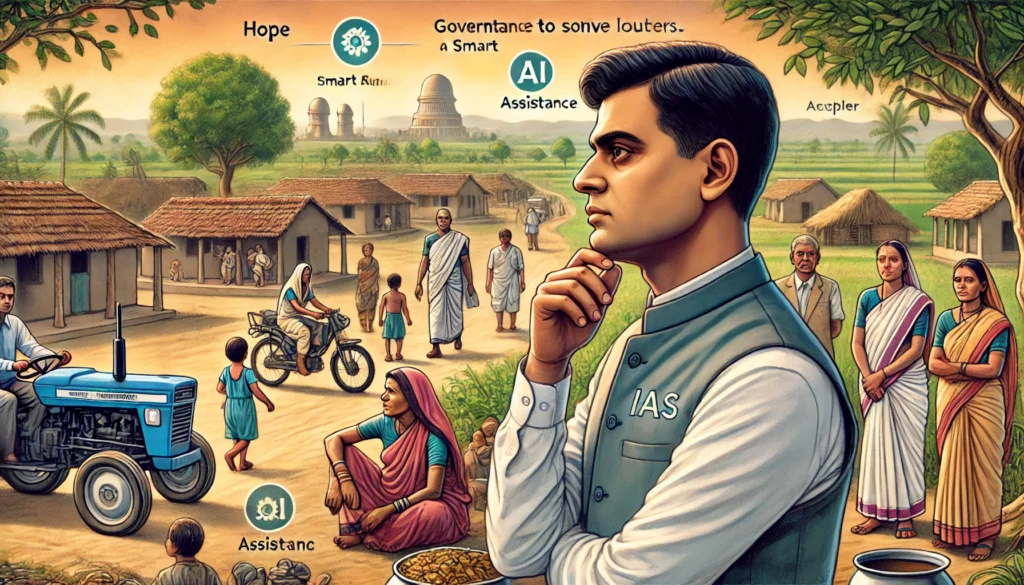
AI as a Doctor: Transforming Rural Healthcare
In many villages, the nearest hospital was 80 km away. Patients often suffered because they couldn’t reach a doctor in time. Jayat Naheta realized that while he couldn’t immediately build new hospitals, he could bring medical knowledge closer to people.
How AI Helped:
- An AI-based Chatbot for Medical Diagnosis
- He developed a ChatGPT-powered software named GPPT Pushpa Health Assistant.
- This tool allowed nurses and health workers to assess a patient’s symptoms and provide immediate medical guidance.
- It asked five simple questions to analyze symptoms and recommended possible treatments.
- Telemedicine for Doctor Consultations
- He introduced telemedicine services where patients could connect with doctors via video calls.
- This drastically reduced unnecessary travel, helping over 100 patients daily get the right medical advice without leaving their village.
Impact: Patients no longer had to wait for days to get medical help. Even in emergencies, AI-assisted healthcare was available instantly.
AI as a Teacher: A New Era of Learning
Dantewada faced another crisis: Many schools lacked trained teachers.
Jayat Naheta saw AI not as a replacement for teachers but as a support system that could fill the knowledge gap.
How AI Helped:
- AI-Powered Learning in Schools
- In 600+ schools, students now use AI-based interactive learning tools every Saturday.
- Instead of traditional books, students bring mobile phones where AI-powered chatbots teach them new concepts.
- Training Teachers to Use AI
- Over 1,000 teachers were trained on how to integrate AI in the classroom.
- Even teachers with limited resources could now use AI to provide high-quality education.
Impact: Students now receive better education, with AI acting as a learning assistant where teachers are unavailable.
A Smart Use of AI: Lessons for the Future
The success of Dantewada is not just about AI technology—it is about smart leadership. Jayat Naheta did not bring AI to replace doctors or teachers; he used it to empower them.
What We Can Learn:
✔ AI is a Tool, Not a Replacement: It can assist healthcare workers, teachers, and government officials but cannot replace human empathy and decision-making.
✔ Leadership Matters: Technology alone does not create change; leaders with vision do. Jayat Naheta’s bold decision to integrate AI into public services is what made the difference.
✔ AI for Social Good: Instead of fearing AI, we must explore how it can solve real-world problems—be it in healthcare, education, or governance.
The Road Ahead: AI for Every Community
Dantewada’s success story is just the beginning. If an IAS officer can use AI to bridge social gaps, imagine what can be achieved if more government departments, NGOs, and individuals adopt this approach.
What If We All Thought Like This?
- What if AI-powered health assistants were in every village?
- What if schools across India used AI to support teachers?
- What if government services adopted AI for efficiency and accessibility?
The possibilities are endless. The real question is: Are we ready to embrace AI not just as a technology but as a force for social change?
Dantewada’s story teaches us that one smart idea, combined with AI and leadership, can change thousands of lives. The future is not about AI replacing humans; it is about humans using AI intelligently to build a better world.
Are we ready to take this step forward?


