
Have you ever wondered why some people learn new skills so quickly while others struggle? The answer lies in how the brain works when we acquire new knowledge and habits.
Learning isn’t just about effort—it’s about understanding how your brain forms new connections and how to leverage this process effectively. Whether you want to learn a new language, master public speaking, or become an expert in digital marketing, harnessing the power of your brain can accelerate your progress.
Let’s dive into the science behind learning, the four stages of skill development, and five proven techniques to learn anything faster.
🧠 The Science Behind Learning: Neuroplasticity & Dopamine
Neuroplasticity: The Brain’s Ability to Change
Every time you learn something new, your brain forms new neural connections. This process is called neuroplasticity—your brain’s ability to rewire itself based on experiences and practice.
🔹 When you repeat an action, the neurons communicating that action fire together.
🔹 Over time, the connection strengthens, making the skill easier and more automatic.
🔹 If you stop practicing, those connections weaken, and the skill fades.
Think of it like a hiking trail: The more you walk a path, the clearer and easier it becomes. But if you stop using it, the trail gets covered in weeds.
Dopamine: The Reward Chemical That Keeps You Motivated
Your brain is wired to seek rewards. When you accomplish something new—like solving a difficult puzzle or learning a new guitar chord—your brain releases dopamine, a chemical responsible for motivation and pleasure.
✅ Dopamine boosts focus and excitement.
✅ The more dopamine released, the more likely you are to continue learning.
✅ This is why small wins matter—they keep your brain engaged!
To keep your learning process effective, celebrate small milestones—every new skill learned, every improvement made. This will reinforce the neural pathways and keep you motivated.

📈 The 4 Stages of Learning Any Skill
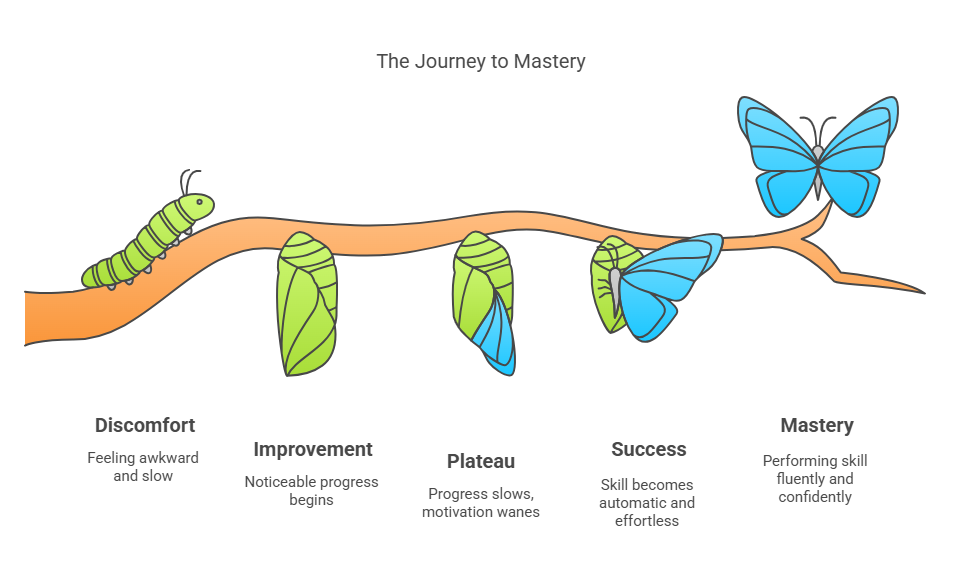
Learning is not a straight path—it has four key stages:
1️⃣ Discomfort (The Frustration Phase)
This is the hardest stage. You feel awkward, slow, and discouraged because your brain is creating new neural pathways.
🔹 Example: When you start learning to play the piano, your fingers feel stiff, and you can’t coordinate them properly.
🔹 Solution: Push through! This is a necessary phase before improvement.
2️⃣ Improvement (The Growth Phase)
Your brain starts making stronger neural connections, and things get a little easier. You still struggle, but you notice progress.
🔹 Example: You can now play a simple tune on the piano without looking at your hands constantly.
🔹 Solution: Keep practicing consistently—momentum is key!
3️⃣ Plateau (The Boring Phase)
At some point, progress slows down. It feels like you’re not improving, even though your brain is still making adjustments. Many people quit at this stage.
🔹 Example: After a few months of piano practice, you feel stuck, unable to improve further.
🔹 Solution: Switch up your learning methods (e.g., challenge yourself with harder pieces or get feedback from a teacher).
4️⃣ Success (The Mastery Phase)
After consistent practice, the skill becomes automatic. Your brain has built strong neural pathways, making it easier to perform the skill effortlessly.
🔹 Example: You can now play songs fluently without thinking about finger placement.
🔹 Solution: Keep refining your skills and teach others to solidify your knowledge.
🚀 The key to mastering any skill? Keep going—even through discomfort and plateaus.
🔥 5 Proven Strategies to Learn Any Skill Faster
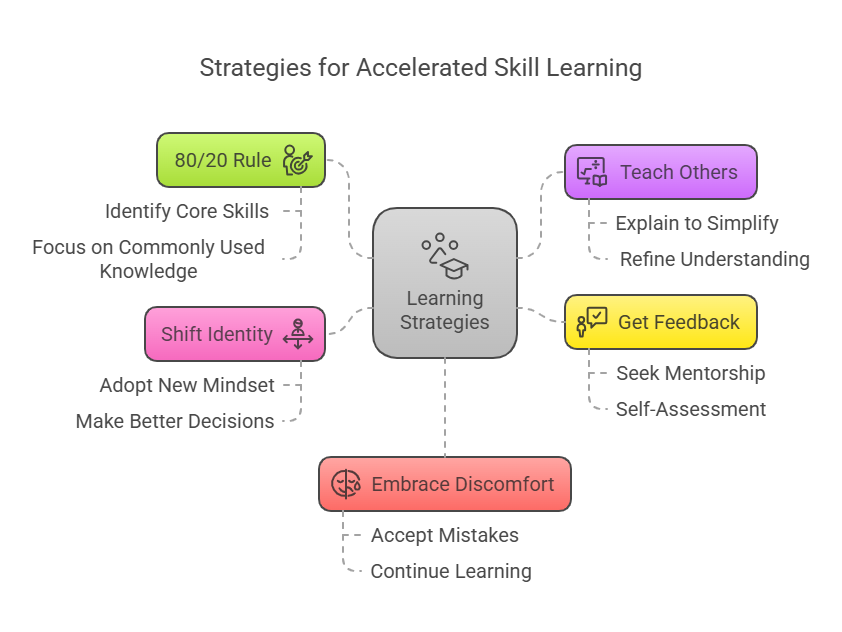
Now that we understand how learning works, let’s explore five powerful methods to speed up your learning process.
1️⃣ The 80/20 Rule (Learn What Matters Most First)
The Pareto Principle states that 80% of results come from 20% of efforts. Instead of trying to learn everything, focus on the most impactful parts first.
🔹 Example: Learning a new language? Instead of memorizing thousands of words, focus on the 1,000 most commonly used ones.
🔹 Tip: Identify the core skills or knowledge that will give you the biggest advantage.
2️⃣ Teach Others (The Feynman Technique)
One of the best ways to deepen your understanding is to teach what you’ve learned. This forces your brain to simplify and organize knowledge.
🔹 How to do it?
1️⃣ Learn a new concept.
2️⃣ Explain it in simple words as if teaching a 5-year-old.
3️⃣ Identify any gaps in understanding.
4️⃣ Refine and simplify your explanation.
✅ This method strengthens memory and clarity!
3️⃣ Get Feedback (Break the Illusion of Knowledge)
We often think we’ve mastered something until we get tested. Feedback from mentors, coaches, or even self-assessment helps identify weaknesses.
🔹 Example: If you’re learning photography, sharing your work with a professional can highlight areas to improve.
🔹 Tip: Actively seek feedback and be open to criticism—it’s a shortcut to improvement.
4️⃣ Shift Your Identity (Think Like a Master)
Instead of saying, “I am learning piano,” start saying, “I am a pianist.”
🔹 Why? Identity-based learning trains your brain to act accordingly. When you see yourself as a professional, you make better learning decisions.
🔹 Example: If you’re learning coding, start identifying as a coder—this mindset shift improves commitment.
✅ Act like the person you want to become, and your skills will follow.
5️⃣ Have the Courage to Feel Worse
Many people quit learning because they hate feeling like a beginner. But feeling bad at something is part of the learning process.
🔹 Example: When learning a new skill, you will make mistakes, feel slow, and doubt yourself—this is normal!
🔹 Tip: Accept the discomfort, embrace mistakes, and keep moving forward.
✅ The best learners don’t avoid failure—they embrace it.
🎯 Final Thoughts: Learning is a Superpower
Learning isn’t about talent—it’s about strategy and consistency. When you understand how your brain learns, push through the discomfort, and apply these proven techniques, you can master any skill.
🔥 Which strategy will you try first? Let us know in the comments!
📌 Stay inspired with more personal growth insights at TheSuvichar!


